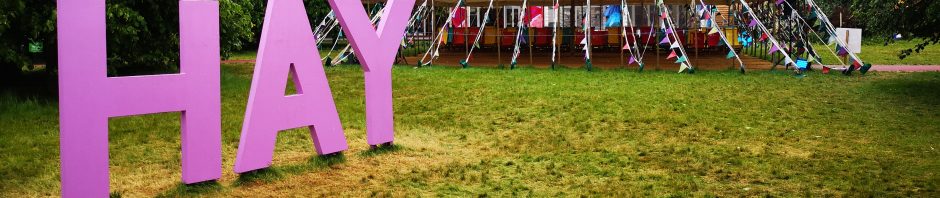
The sun certainly shone brightly on Hay Festival 2026, and glorious amounts of book fiends descended to on our border town to fill their bibliographical hearts full of wonder, delight, and books, books, books! This year book sales were up and so was festival attendance too. This all bodes well for next year as the festival celebrates it’s 40th year.
Hay Writers’ Live!took place on Sunday 31st May at 12.35pm in the Bookshop Garden Marquee. An outdoor venue without microphones was something new for us, but our stoic group stepped up to perform (against the backdrop of the neighbouring musician’s amps); their bespoke festival creation, The Well of Words. Short individual pieces inspired by books, poems and even lullabies were performed in the guise of a masked classical Greek Chorus. Our event was very well received by the audience and in return, we would like to convey a huge thank you to everyone who came along and supported us on the day.
We also sincerely thank the festival for its continued support of local writers. For many of our younger HWC members the opportunity to perform their own work at Hay Festival gifts them an enormous boost of self confidence and belief. Hay Writers’ Circle was first invited to perform at Hay Festival in 2005, 21 years ago, and we look forward helping Hay Festival celebrate it’s incredible 40th anniversary in 2027.
Photo Credit – Margaret Blake 2026
Hay Festival Writer At Work hosting a Creative Writing Workshop
There is still time to book your place on our exciting Creative Writing Workshop with Holly Müller. Holly was one of the Hay Festival 2026 Writers at Work and we are thrilled that she is leading this dynamic writing workshop on Tuesday 9th June. Details about Holly, and the workshop can be found below. A light lunch is included, so please make us aware of any dietary requirements when booking. Please book your place via email to our Chair, Corinne Harris: corinneonwye@gmail.com
HOLLY MÜLLER
“Holly Müller is a writer and musician living in the Bannau Brycheiniog. Her debut novel My Own Dear Brother (Bloomsbury, 2016) was Waterstones’ Book of the Month and garnered positive reviews in the Guardian, Independent, Sunday Times, Sydney Morning Herald and more. Her short stories are published in Rarebit (Parthian Books, 2013) and New Welsh Fiction (Seren Books, 2015). Holly achieved a PhD in Creative Writing from the University of South Wales where she taught undergraduates. Holly has written for national press as well as prominent online publications and has performed at Cheltenham, Hay, Laugharne, and Cardiff Literature Festivals.”
The Richard Booth Prize for Non-Fiction 2026
There is a little over once month to go before the deadline for our Non-Fiction Prize. We are thrilled that award winning author, Ruth Pavey, is our judge this year’s Richard Booth Prize, and we hope to receive some fascinating entrees.
Full details on how to enter can be found on our COMPETITIONS page.
Time to get writing!
Illustrator Opportunity!
HWC member, Nicholas Thomas, has created a short story, “Lark and Hedghog“, and is currently seeking an illustrator.
Please read the story (below) and get in touch with him via email : n.thomas559@btinternet.com
Lark and Hedgehog
Having rescued the Princess Arabella the services of the Tusketeers were much in demand but they couldn’t do everything so they would ask their friends to help.
One day a Mrs Beryl Hedgehog came to see them, she seemed very upset.
“What seems to be the trouble Madame?” asked Red, but as she was a prickly hedgehog he didn’t put his arm around her to comfort her.
“It’s my Gerald,” she said, “he’s gorn missing.”
“Gorn,” thought White disapprovingly, he was such a snob.
“Oh dear, tell us all about it,” said kindly Blue.
“Well it were like this,” said Mrs Hedgehog, “Gerald went off to school yesterday but never arrived, it wasn’t until I went to collect him that I realised he hadn’t been there, his teacher said he hadn’t been there all day.”
“Oh heck,” I thought, “where can he be?”
We searched high and low and spoke to his friends when young Gavin told us that Gerald had been telling him about some hedgehog tunnels that had been built under a new road near the Harlestone Firs and how he was interested to see them.
“Oh dear they’re miles away,” said Blue, then Red piped up, “I could ask my friend Lark to fly over and take a look,” he said.
He hadn’t seen Lark for quite a while she was always too busy bringing up her own children but now that they were able to be looked after by their granny she agreed to look and wasting no time off she flew.
Fortunately that day there was a tailwind and she very quickly found herself over the Firs and headed towards the perimeter road.
Seeing some sort of commotion on the verge she hovered to look and flew down to see a most extra ordinary sight.
There at the roadside was a group of animals all trying to pull on a dog’s tail, the dog’s body being firmly stuck in a pipe that led beneath the road.
“My goodness,” she tweeted, “what’s happened?”
“Oh,” said a harvest mouse, “Fat Sally, Jack Spratt the dachshund’s wife followed him into the hedgehog tunnel and has got stuck. She had followed her slim husband who was heading to the Firs but she’s got stuck and we can’t pull out.”
Now unbeknown to all of them Gerald the missing hedgehog had seen what was happening and being a clever little hedgehog he had a plan. He had seen that those tugging were not having a lot of luck despite trying to lubricate the dog by pouring questionable liquid over the dogs back. All they were doing was making the dog howl as her tail was pulled harder and harder.
No, it needed something else and he thought he knew what if only he could find what he needed. So off he went foraging through the wildflowers along the roadside and there amongst the Hearts Ease and Scarlett Pimpernel he saw what he was looking for, a tiny white flower nestling beneath a bramble. Achillea ptarmica, also known as Sneezewort. He tore off some dried out flowerheads and headed back to the tunnel, travelling along the tunnel was very dark as the stuck dog had cut off light from the end he was travelling towards but some glowworms helped light the way. Once there he ground the Sneezewort as best he could then, hearing the others heaving on the dog’s tail, he stuffed the Sneezewort up its nose. After a moments shock and hesitation the dog let out an enormous sneeze and out it popped rolling over those pulling its tail. Gerald, who had been blown backwards in a ball shot along the tunnel and landed on the verge by the Firs. The glowworms were blown out like candles.
He emerged into the light to great cheers, when the celebrations settle down Lark hopped over and told him he had to go home as his mother was very worried. Mind you Lark had already sent a message via the bird telegraph back to base. So when he eventually arrived home it was to a hero’s welcome, even his mother didn’t box his ears for wandering off, she just gave him a big hug and told him he mustn’t do it again.
The end.
Nicholas Thomas, May 2026.
To keep up to date with all our competition and workshop news etc., why not subscribe with your email address in the box below.
The sunshine has really welcomed the crowds to Hay Festival 2026. Glorious bright days and sultry evenings are thronged with book readers, book bearers and every manner of literary lover. All are intent of meeting their author idols, soaking up the heady festival atmosphere, or strolling the short walk into town for a Castle visit, ice creams, boutiques, pubs, cafes and even more excellent book shops. Many meander back to the festival site via the Warren Walk, taking in the lush views of the River Wye. Yes, Hay is at it’s best and everyone is enjoying it.
Hay Writers’ Circle are delighted to once again be at Hay Festival, and we are so grateful to the Festival for it’s continued support of local writers. This year we will be reading alfresco in the Bookshop Garden Marquee at a FREE drop-in event (event number 394). The theme of our readings will be “The Well Of Words”, original writing by our members on poems, books and even lullabies which have inspired or influenced us. Perhaps our own small nod celebrating the National Year of Reading.
We do hope you can can come along, enjoy our words, and stay for a chat afterwards.
Poetry Competition 2026 – 2nd and 3rd placed poems.
Many congratulations to Hilary Watkins and David Shields who won 2nd and 3rd places respectively in our 2026 Poetry Competition as judged by Lesley Saunders. First place was won by Livia Frisby Parker Clements, and her winning poem, “Advice from the Widow Next Door” appears in our previous article.
Hilary WatkinsHilary Watkins and Jay the Sheep.
Hilary Watkins – “Home“, 2nd Place.
“I think the best way to get to know someone is to ask them what they love. Words are number four on my list – one place behind silence. Poetry does both well I think. And both feature highly in my choice of work, the silence, when dog sitting and gardening and, previously, words, when storytelling or working with young adults. Whatever the paid work, I make space for writing both poetry and adult fiction.
I love sheep, only fractionally less than words, I am a sheep farmers daughter. I was raised and live in the foothills of the Black Mountains, yet work has taught me to travel well, to live out of a suitcase or inside a book. Upon my return, I notice that words are, most often, musical sounds exchanged in the sheep shed or ‘on the road’. Perhaps this is why I appreciate Mary Oliver’s emphasis in her book, A Hand Book of Poetry, that ‘to make a poem, we must make sounds. Not random sounds, but chosen sounds’. So my thanks go to the Hay Writers Circle, for giving each entry in the competition an opportunity to fly from the page.”
Home by Hilary Watkins
Home, for me, is more a way of being
than a place. I can do it in many places but not all.
That way of being is in emptiness
where something gives –
and my gaze alights and lingers on spaces
between the branches of wintering trees,
and the few leaves, still fast and
holding their colour green,
and in the foreground, on the windowsill, the arrangement of
three onions in a bowl, intoxicating and
inspired in their wine-red chafed skins,
making counterpoint with ivory bulbs of garlic.
David Shields
David Shields – “Getting to Grips with the Resistometer” & “Change of Use”, Joint 3rd Place
David Shields lives in Crickhowell and works in Brecon Library, where he organises regular literary events and group sessions. He has an MA in Writing from Sheffield Hallam University, and has published poems, essays and reviews in numerous publications. He is a multiple Spectator writing competition winner, and won the inaugural Knighton Poetry Prize in 2025.
Getting to Grips with the Resistometer by David Shields
Like old men tottering on sticks
We walk one pace then plant the spikes
Wait for the registering click:
We are doing geophysics.
March has its ‘lion’ head on.
We bow before the wind-sown rain,
Intent on the reading and the line,
Our progress boustrophedon.
At the line’s end I pass the yoke
To my partner, follow in her wake
As she now wields the virtual rake,
Piling data in a tidy stack.
The archaeologist also follows
As the terrain now dips and narrows,
With the odd word steadying the harrow.
At last the foursquare field is furrowed.
Later we huddle, as if for warmth,
Round the laptop, watch the solid graph
Leap amazingly to life:
Waves of stone, locked in the frozen earth.
Change of Use by David Shields
(Land acquired by Orchard – construction site hoarding)
If only.
If this were a greening
for a gauze of grey,
laid like a poultice
on the wounded land.
If, for a web of glass and steel,
dense trees would aggregate
a mesh of shade,
woody girders pleached and spliced.
Book Now for our Fiction Workshopwith Holly Müller
There is still time to book your place on our exciting Fiction Writing Workshop with Holly Müller. Holly is one of the Hay Festival 2026 Writers at Work and we are thrilled that she is leading this dynamic creative writing workshop on Tuesday 9th June. Details about Holly, and the workshop can be found below. A light lunch is included, so please make us aware of any dietary requirements when booking. Please book your place via email to our Chair, Corinne Harris: corinneonwye@gmail.com
HOLLY MÜLLER
“Holly Müller is a writer and musician living in the Bannau Brycheiniog. Her debut novel My Own Dear Brother (Bloomsbury, 2016) was Waterstones’ Book of the Month and garnered positive reviews in the Guardian, Independent, Sunday Times, Sydney Morning Herald and more. Her short stories are published in Rarebit (Parthian Books, 2013) and New Welsh Fiction (Seren Books, 2015). Holly achieved a PhD in Creative Writing from the University of South Wales where she taught undergraduates. Holly has written for national press as well as prominent online publications and has performed at Cheltenham, Hay, Laugharne, and Cardiff Literature Festivals.”
To keep up to date with all our competition and workshop news etc., why not subscribe with your email address in the box below.
We are thrilled to announce the results of the Hay Writers’ Circle Poetry Competition, 2026.
This every popular competition received a good number of entries from both inside and outside Hay Writers’ Circle and we very much welcome all external interest in our writing competitions.
We must firstly take a moment to thank our amazing 2026 Poetry Judge, Lesley Saunders, who has read all the entrees and whittled them down to our ultimate set of prize winning poems.
Lesley Saunders, 2026
Lesley wrote,
“I want to salute all the entrants who sent in their poems to the competition – I know from experience that it takes courage to submit one’s work for scrutiny and judgement by someone else. Just by entering the competition, writers have taken their writing a bit more seriously. My advice to people who weren’t successful in this competition is: keep trying, but above all keep writing. And I also want to honour the depth of emotion that inhabits many of the poems. I think that testifies to how we look particularly to poetry to hold and express our thoughts and feelings in these sad and difficult times.”
Thank you Lesley.
(Lesley also took the time to write constructive feedback notes for all competition entrants, these appear at the end of this update.)
Hay Writers’ Circle Poetry Competition 2026 – Results!
First Prize – Advice from the Widow Next Door, byLivia Frisby Parker Clements
Second Prize – Home, byHilary Watkins
Joint Third Prize – Change of Use, by David Shields, and Getting to Grips with the Resistometer, by David Shields
“Livia Frisby Parker Clements is currently studying A levels at Orleans Park School in Twickenham and plans to apply to study Veterinary Medicine at university. Alongside this, she is taking English Literature as a fourth A level, reflecting her love of reading and creative writing. She has been writing poetry for the past three years, often drawing inspiration from Gothic and postmodern literature, which has become her favourite creative outlet.”
The Winning Poem
Advice from the Widow Next Door byLivia Frisby Parker Clements
Listen to me girl, you cannot dress this up, sweep it under layers of mascara
and concealer, stand still when you hear it crunch between clenched teeth
or twist it into some hollow tragedy because I know you long for people to notice
the stains it tracks over your smile, your voice the oh so soft skin of your cheek
but nobody will see past your rosy lips too blinded by the white glinting in your mouth,
too drunk on the honey in your tone, too busy tracing the freckles on your jaw
I know you could draw around each slab of flesh left withered by his touch
listen to me girl, you cannot dress this up
when he shows up on your doorstep do not invite him in
instead grab your keys, a broken beer bottle, your father’s rusted axe
tread lightly and on the seams of the floorboards,
still the tremor in your hand and the fluttering bird behind your ribcage
though, be honest, that bird has long since died so use the carcass
to lure the predator and, listen to me girl,
aim for the neck.
We will be sharing the other placed poems, and their author bio’s in our next update.
In the mean time, huge congratulations to our winner, Livia, all our placed poets, and to everyone who entered our competition. Well done all!
Poetry Competition Feedback from our Judge, Lesley Saunders.
” I’d like to share a few tips that emerged from both the successful and the unsuccessful poems:
1. Less is more – good poetry often works because of its economy of expression; see if you can compress your poems by using allusion and metaphor – trust your readers’ intelligence!
2. Find a different angle – human experiences and emotions (love and death and the whole damn thing, to paraphrase the film title) have been written about since the dawn of time. How can you find a new way into thinking and writing about yours?
3. The shocking nature of catastrophic events and actions, such as in Ukraine and Gaza, makes many of us want to articulate our outrage and express our empathy. But it often works better to come at such topics obliquely – it can sound artificial or even voyeuristic to write too directly about someone else’s extreme experience.
4. If you want to use a formal rhyme scheme, don’t be ruled by it – read Paul Muldoon and Philip Larkin for brilliant ways of writing rhymefully
5. To write good poetry you need to read good poetry, including at least some works by poets of the 20th and 21st centuries. Otherwise you may be working with a restricted idea of what is ‘poetic’. On the other hand, you need to be able to say why what you have written counts as a poem rather than prose broken up into lines.”
And Finally,
Reminder of our Fiction Workshop – Tuesday 9th June, 2026
To keep up to date with all our competition and workshop news etc., why not subscribe with your email address in the box below.
Submissions are now invited for our annual Non-Fiction Competition, The Richard Booth Prize 2026, named after one of Hay-on-Wye’s most notable residents and it’s self proclaimed ‘King of Hay’. Richard was always a great supporter of books, Hay-on-Wye and of course, local writers.
Sadly, Richard passed away in 2019, but his name lives on everywhere in Hay, including this writing prize which he so graciously sponsored during his lifetime and we continue to honour in his memory.
Richard Booth (King of Hay) 1938-2019
This year we are thrilled to confirm that the judge for our Non-Fiction Competition isRuth Pavey.
“Living mainly in London, Ruth has had a mixed career, as gardener, teacher of art and English, reviewer, gardening columnist and (not in London) woodland grower. She has written two illustrated books about her Somerset woodland-cum-orchard project; “A Wood of One’s Own” (a Sunday Times Book of the Year), and “Deeper into the Wood”, both published by Duckworth Books.
As a writer late to publication, she admires everyone who writes from the heart and doesn’t give up….”
Ruth Pavey
Anyone can enter this competition. 500-1250 words. The theme is entirely open. Original unpublished writing on any subject will be accepted. Closing date is Tuesday 7th July 2026. Any entries submitted after the closing date will not be considered. Good luck!
For full competition guidelines and the entry form, please head over to our Competitions page.
The Bookseller of Hay: The Life and Times of Richard Booth by James Hanning. (Emma van Woerkom)
Richard Booth, where do you start? This book is as good a place as any to get an inkling into the many layers of his life. As James Manning admits, to some Richard was a “shambolic, egotistical, capricious, unreliable spendthrift”, others saw him as a “benign, paternal, swashbuckling advocate of the common man”. What James has drawn together here is a range of people’s personal recollections interspersed with written material, which includes some of Richard’s own diary entries.
Among many stories of celebrities, folk from Hay and beyond; book festivals, institutions and sellers, and the varied relationships they all had with Richard, we view the inception and formation of his book shop empire. He created the Kingdom of Hay, and thus his kingship, we witness his remarkable promotional skills, his continually anarchic financial escapades, and latterly, his firm ethos that his book-town model should be duplicated around the world.
It was a joy to read about so many people I know and have known. I particularly favoured the explanation of Jeffery Meadon’s encounter, and subsequent high court battle with Booth. I crossed paths frequently with Jeffery later in his life, and he never fully explained his vitriolic stance on Booth, he just called him a rogue and spoke bitterly about him.
A few years later I met Richard and Hope at a lunch for Hay Writers’ Circle. Richard (during his lifetime) gave his name to their annual Non-Fiction Competition and donated the prize money. The prize (as you see) still bears his name as a tribute to his support of local writers. On that day he was utterly charismatic, excitedly brimming with ideas of going to Iceland to advise on setting up a book town there. He praised and marvelled that an average of one in ten Icelanders published a book during their lifetime. He asked me to join his party and go to Iceland. I had just started a new job elsewhere and made my disappointed excuses.
But it was a joy to speak to him on that day, and I can see how so many people were captivated by his ambitious dreams. It reminds me of this quote from T. E. Lawrence, “All men dream, but not equally. Those who dream by night in the dusty recesses of their minds, wake in the day to find that it was vanity: but the dreamers of the day are dangerous men, for they may act on their dreams with open eyes, to make them possible”.
Richard Booth was a quintessential day dreamer, and this book aptly brings that to the fore.
The Bookseller of Hay : The Life and Times of Ricard Booth by James Hanning Publisher : Corsair ISBN 978-1472159786 Available at all good bookshops including the Hay Festival Bookshop – https://www.hayfestival.com/p-24525-the-bookseller-of-hay.aspx
Hay Festival 2026
Join Hay Festival 2026, 21st–31st May. The full programme is out!
“Come and hear the writers share and discuss some of their recent work. The Hay Writers’ Circle is a dynamic group, active in Hay for more than 40 years. It offers three competitions annually for poetry, fiction and non-fiction, each of which is open to both members and non-members. There is an active work in progress group for those working on longer projects. The Circle has an ongoing, productive relationship with a local primary school.”
copyright – ECvW 2025
Something from the HWC Archives
(HWC 2001 Magazine, Issue 2, page 19)
THE FIRST URBAN SPRAWL, 1935 by Vera Fairfax
There was a pond and, in season, croaking frogs A much walked path and rabbit hole dogs Protruding tails wagging, with never a rabbit caught Scratching, yelping, barking, snarling, all for nought.
Celandines first, then bluebells in shady places Daisies, white and joyful and golden buttercup faces. Leg tickling quaker grass, thistles, booming bees And, ruling over all, the kindly leafy trees.
The oak stood alone, spreading branches blessing all, Giving shelter, shade to youthful plans, adventure to recall. For childhood dwelt in that wondrous place, dreams and nature were ours. For it was always there, each grass we knew we shared in playlit hours.
Girls wearing frocks played house, all very self reliant. Boys in short trousers were pirates, wild and bad and defiant, Intent on destruction. Then came years of sport, Football, racing, rounders and excited cries, ‘Well caught!’
But the city, spawning suburbs, was slowly, surely, creeping. Chainsaws felled the oak, beeches, ash fell weeping. Houses were built. Where went the frogs? No use yelping for rabbits for back garden dogs.
We were casual, uncaring, for the world and a war were beckoning And when Paradise was swept away, we hardly guessed the reckoning. For Life moved us on to live, leaving memory in the wildwood, With the dogs, rabbits, frogs, flowers, bees and childhood.
To keep up to date with all our news, competition, workshop and event details etc., why not subscribe with your email address in the box below.
We swing into this latest article with the 2nd and 3rd placed winners as judged by Holly Müller from our recent Frances Copping Memorial Prize for Fiction Competition 2026.
To read the full judges comments on all the winning entries, please CLICK HERE
2nd place – The New Walk
‘The New Walk’ is an unusual, vivid and impressionistic story with playful and inventive use of language. I enjoyed the refreshing effect of defamiliarization, the sense that the storyteller is a watcher, looking at ordinary sights, sounds and happenings through a different lens…” Holly Müller
The New Walk by Catherine Smedley
I walked at a leisurely pace along a wide pedestrian footpath, The New Walk, lined with trees and strips of grass. On a bench by the side of the path were three men, surrounded by a colourful abstract of trash. They pointed enquiringly at the viola case I happened to be carrying.
I walked at a leisurely pace along a wide pedestrian footpath, The New Walk, lined with trees and strips of grass. On a bench by the side of the path were three men, surrounded by a colourful abstract of trash. They pointed enquiringly at the viola case I happened to be carrying.
“What’s that then, a machine gun?”
With one fierce burst of ammunition fire I shot them dead. Obligingly, in unison, they slumped onto the grass in slow motion, smiling, groaning and clutching their wounds. The blood, which didn’t seep into the fresh green grass, reminded me of the vibrancy of complimentary colours and Kandinsky. A few yards on I turned back and watched them jovially dusting each other down.
The clock struck twelve and the day was half cooked. It always rises perfectly but someone impatiently opens the oven door to see and the centre feels the cold air and sinks. .
I pass streamers of children, weaving and floating, blown from straight paths, attracted like magnets to iron railings, cherry blossom and the precision of kerb stones. They popped like toy guns firing percussion caps. They are the fearless tight-rope walkers unaware of anything but their free flowing dance. They are the brightest spots in the frame that catch light by the handfuls and wont give it back.
I was much too early, so I seated myself on one of the benches encirling the Museum gardens.. I watched in front of me, a meeting well under way of a man and a woman, the latter leaning elbows against the sundial centred in the grass square. Her face was velvety and soft as if trapping light beams between the fibres. His expression was the epitomy of indifference, where no lines gave any clue as to what lay under the skin like a vertical lake undisturbed by even a breath of wind. Her mouth was red, a guerrish colour, spitting out words as missiles to catch old wounds on the raw. At one stage she seemed to imagine that she’d said something amusing. The ensuing slender smile was drawn as thinly and evenly as the arc from a pair of compasses with a finely sharpened pencil. Perhaps their conflict was not with each other but with that which separated them, related as the rim of the shadow on the sundial was to the perimeter of light. A big fat cloud obscured the sun and the scene suddenly lost its contrasts. The couple, if that is what they once had been, separated. Pistols at dawn and they had both missed their targets.
On the bench adjacent to me sat three women with technicolour nails, each rocking prams gently by nudging the wheels with their feet. They talked about the price of oven chips and the bug that was ‘doing the rounds’. Eyes firmly fixed on their mobile phones they didn’t look at each other or their offspring but kept up a running disjointed commentary on what they were seeing and texting.
The syncopated ‘pop’pop’pop’ of the mobiles sounded like a distant rifle range. But oh! the dexterity and speed of contemporary fingers!
I read my book for a while then dawdled back to the path and turned into the Museum. From the basement came the rustling of scores to settle, turned by fingers long and supple. The musicians began to tune up. The two violinists and the cellist tightened the strings on their instruments which had comfortably relaxed in the heat. The double bass player rumbled in last. The quartet were symetrically arranged behind a shallow indoor fish pond. In it a dozen goldfish of differing sizes, swam in complete oblivion to the music due to their water insulation. The water was clear and the mosaic patterned tiling on the bottom of the pool could be seen in deep blue and crimson. The scant audience impatiently shuffled their chairs from side to side. The sharp squeaking and squealing of the chair legs on the tiled floor adding the beginnings of an avant garde percussion section. The programme was very simply designed and contained only very basic information; musicians and their instruments, order of pieces and names of composers. There could now be observed a distinct air of anticipation as musicians and audience inched forward to the edge of their seats. A freestanding clock in the corner solemly donged three. What sounds would fill the space and echo, the sound of ripening apricots?, the murmur of a forest floor? an explosive overture of artillery?
The air of expectancy gradually dissolved due to the melancholy nature of the performance and five minutes into the programme a fog of depression set in. The audience once more slumped back to chair back.
During the interval I noticed that attempts at conversation were being made over tea in the Egyptian section. I stirred some sugar into my cup and turned my gaze on a mummified cat in a display case. I focused however on a reflection in the glass of a man and two middle-aged women who stood behind me, exchanging polite but nervous smiles and nibbling ‘nice’ biscuits. Then the tension broke. The man became animated, swinging his head from side to side and equally directing his monologue between the two, now utterly entranced, ladies. This made it difficult for me to hear but I gathered that his excitement focused on what he called “ the phenomenon”. I could not guess at what or where this phenomenon might be but a large part of our twenty minute interval was dedicated to it. I was impressed by the fact that both women showed not a glimmer of boredom but were captivated by either the man, the subject, or both. I learnt that “the phenomenon”, formerly unknown, was much misunderstood. Apparently a keen observer may see the phenomenon exhibited by a prism, and if they cared to move their heads backwards , while half closing the eyes, the phenomenon will appear reversed. The same phenomenon is also exhibited at sunset, making a sharp indentation in the horizon.
As we resumed our seats someone inquired into my apparent fascination with mummified cats. I described the reflective properties of glass. During the second half of of the concert I made several attempts to master the art of origami with the help of my programme. I folded a half decent frog and a deformed crane. The bass player had set the tone and was fractionally behind the beat in his playing. He brought the last piece to a climax with a booming hand grenade of sound. We all clapped politely and minimally at the end. I made my way to the exit via the aquarium where a large pike fish kissed me through the glass. The Museum was both a house of curiosity of the dead and an unhappy prison for living things.
Outside, the wind was beginning to blow cooler air and the world rippled like the surface on a bowl of soup and a thin skin of sleep began to form. It was beginning to be apparent that the day was not a day at all but merely the shadow of the day before. I reached the bottom of the New Walk. Eyes intent on the horizon I searched for an indentation.
Catherine SmedleyHilary Alcock
3rd place – Cully’s Collar
“A story from a dog’s perspective, which succeeds in capturing the world of the family black lab on Christmas Eve, including an adventure to see off some poachers. What I liked about ‘Cully’s Collar’ was its focus on the dog’s world view, which led to some interesting ways of seeing and magical descriptions, for instance of the night sky: “tiny dots of silver lights high above and the huge pale plate hanging above the black mass of the wood”.” Holly Müller
Cully’s Collar by Hilary Alcock
My family are doing strange things this evening. I watch from my outof-the-way dog bed. This afternoon they brought in a tree – not an ordinary one but a prickly all over green one. Now they’ve put it in the living room and She and Little She have hung lots of shiny things on the branches and He has put strings of coloured lights round it. There is cooking happening now which is most odd as they have eaten their late meal. Now Little She is wrapping paper round different things; why tie up stripy pyjamas in paper and put red ribbon round them?
Pyjamas go in the washing machine. Very strange!
I hope I have my night walk as usual; but they all seem very busy-and somehow, excited. I will lie on the kitchen floor and get in the way to remind them that I mustn’t be forgotten.
Big He, my master, is Alec; he takes me out last thing at night before my long sleep. He has a light on the front of his head hat which shines his way through the dark. He has got a new collar for me with little red lights on it which flash, so that he can see me. He says I’m invisible in the dark being a black Labrador.
At last he puts on his hat and coat and fastens on my flashing collar and opens the outside door.
“Won’t be long,” he calls up the stairs to She.
“Watch out for Father Christmas!” She calls back.
Who is Father Christmas? I wonder as I run down the path and wait for Alec to open the metal gate. I go out into the lane. It is cold. All is still. All is quiet. All is dark, except for the tiny dots of silver lights high above and the huge pale plate hanging above the black mass of the wood. On one side of the lane is a field of thick leafy things. On the other are rows and rows of apple trees-bitter fruit- with grass walks between and the woods beyond. I run. It is good to stretch and sniff and be free and go.
Alec walks up the lane following me with my lead in his gloved hand and his light shining out. There is a gap in the hedge further up which leads into the apple rows; my normal route.
But something stops me. There is a smell. I listen. And a faint noise, which is not a breeze amongst the twiggy trees, comes from the distance ahead. It is the sound of an animal in distress. I put my nose to the ground but there is no scent. Then I run -hard- and dive through the hedge at the next gap. The nasty smell of petrol is very strong and I follow it. Well down a grassy walk between two rows of trees is a farm vehicle, parked and dark. The animal sound carries to me again and I run on towards it. A quick look back tells me Alec’s light is coming, bobbing through the bare branches. I hear scraping and tugging and urgent moaning. I run on owards it.
Now there is fear in the air and I pick up the scent of deer. I reach the snared animal and stop. It is pulling with all its strength,making the branches on each side bend and clap together. I cannot understand why it does not run. And then I realise – it is caught ,y wires round its neck.
Suddenly an invisible voice shatters the dark.
“My god! What’s that? Steve come away. There’s a thing with red eyes come through the trees. Steve – come away!”
There are two men running. Should I bark for Alec? But he is behind me. I don’t think he sees as well as I do in the darkness. There is a flash – no two flashes from the black thing he always carries in his pocket. He calls me to him and to sit. He speaks into the black thing.
“Sorry to disturb you so late on Christmas Eve, Jim. It is Alec. I am in your cider orchard 3B. Caught poachers red handed although they have now escaped in a pick-up but I got the registration number. There is a deer caught in a snare here. Need some wire cutters. No- my dog found them-just in time, I think.”
The sound of an engine starting up and tyres spinning on wet grass comes through the darkness from the direction of the parked vehicle.
Alec shines his head light down the grassy walk between the apple trees. The deer is still now but heaving with breathing. It is suffering.
Alec’s black thing rings and he speaks to Jim, directing him to where we are. Soon the pick-up’s bright lights swing round and come towards us blinding me. But hey show the deer; it is a magnificent stag, standing head erect and quivering. It has a huge gash across its neck where a strand of wire cuts into it. Blood drips down its smooth brown skin. Jim stops the pick-up and switches off the engine but keeps the lights shining. He talks to Alec for a bit, then pats me on my head and takes out a long handled tool from the back of the pick-up. Slowly he walks towards the trapped animal and begins to cut branches from the leafless trees. I watch. He reaches the branch where the wire is attached. The stag stands still, seeming to know that this human will help him and not hurt him. I have to sit right back from him because deer don’t like dogs like me. Jim snips the wire but there is another which I have not noticed, and he cuts that too. The stag quivers, feeling the wires loosen, and moves very slightly. Suddenly he is off charging down the darkness, leaving the wires dangling; his hooves throwing up bits of grass and mud.
Jim walks back to Alec and claps him on the shoulder thanking him.
“Good dog you have there, Jim. Wouldn’t sell him, I suppose? I could do with a good poacher hunter!”
“Never,” replies my master, “Happy Christmas, Jim.”
The farmer pats my head and climbs into his vehicle. “You wont forget to send the registration number to the police, will you?”
“I wont,” Alec assures him and calls to me as Jim drives away.
Together we walk up to the hedge, push through the gap and head down the lane for home. The tiny dots still shine up above us but the big pale plate has disappeared. I feel the cold now.
All is quiet at home and Alec takes off my flashing collar.
“Your collar worked a treat, Cully. Those poachers thought you were a monster!” He goes to the fridge. Nice eating things are kept in there! This is looking hopeful. He opens the door. Very hopeful. I am given two fat cooked sausages – what a treat! Two gulps! My dog bed looks inviting and I flop down in it. I hear She call out from somewhere upstairs,
“Did you meet Father Christmas? You’ve been ages!” “Not Father Christmas – just one of his reindeer!” chuckles Alec switching off the lights. It is long sleep time and I am tired.
Poetry Workshop Reminder
Please book your place via email to HWC Chair, Corinne Harris on : corinneonwye@thehaywriters
Hay Writers’ Circle Archives – by ECvW
On a recent visit to see the wonderful Lynn Trowbridge, I was handed a number of historical Hay Writers’ Circle publications. As many of you know, Lynn, one time member and Chairperson of HWC for over 17 years was keen, like the chairs before her, for all writers to have their work in print. The magazines were sold locally raising much needed funds for the group back then, spending the proceeds on professional workshops to improve writing skills and techniques.
Early editors of HWC publications include Bill Mortimer, Moira Henderson and of course, Lynn, with Barbara Erskine providing the foreword for the anthology , A Handful of Hay : Rural Renderings by the Hay and District Writers’ Circle back in 1988.
As we excitedly make our way towards HWC 50th anniversary in 2029, it’s grounding to see such early innovations from our talented predecessors. I am humbled to read these works and delighted that technology is able to scan and preserve these written records for years to come.
HWC Magazines issues 1-4 proof copies 2001-2003
To keep up to date with all our competition and workshop news etc., why not subscribe with your email address in the box below.
Over the next few months we have two exciting writing workshops which anyone can attend (pre-booking essential).
Poetry Workshopwith Lesley Saunders
On Tuesday 5th May, 2026 we have a poetry workshop, One Perfect Rose : Poems with a Punchline, with Lesley Saunders.
Acclaimed poet and teacher Lesley Saunders for a workshop creating poems with a punchline. We tend to associate punch lines with making jokes, the ‘ta-da’ moment after the elaborate run-up, that elicits a groan from the audience. But the idea is more interesting than that, especially when it comes to poetry.
In a poem you can beguile your readers, lull them into thinking they know where the poem is going, and then – – round it off with an unexpected flourish – leave the reader hanging in mid-air – pull the rug from under the reader’s, and your own, feet – have the devastating last word, the last laugh – turn the whole poem – its feeling, its meaning – on its head
We will read and talk about various poems with surprise endings; we will also take a look at the ‘volta’, or turn, in a sonnet; and at the role of form more generally. There will then be plenty of time to work individually and to draft a piece of writing of your own.
“… Why is it no one ever sent me yet One perfect limousine, do you suppose? Ah no, it’s always just my luck to get One perfect rose.” (Dorothy Parker)
Approximate timings: 11.00 am Getting started – round table introductions 11.30 am Reading and discussing resource material together 12.30 pm Breakout for lunch, and for making notes and drafting poems individually 1.30 pm Discussion followed by more drafting / editing 2.00 pm Sharing our thoughts and work 3.00 pm Conclusion and farewell
Fiction Workshop with Holly Müller
On Tuesday 9th June, 2026 we have a fiction workshop, Character Mask : Poems with a Punchline, withHolly Müller. More details of this workshop agenda released nearer the day.
Places for both workshops is strictly limited, pre-booking is essential to secure your place. Please email our HWC Chair, Corinne Harris – corinneonwye@gmail.com
Poetry Competition.
We are into the final couple of days before our annual Poetry Competition closes. Anyone can enter a poem on any theme! First Prize is £100, wish cash prizes for 2nd and 3rd placed poems.
Please find all the information on how to submit your entry on our Competitions page.
Good luck! 🙂
Amanda Ingram – Fiction Competition Winner, 2026!
We were delighted to announce in our last update the much anticipated results of our Fiction Competition 2026, judged by the wonderful Holly Müller.
Our winner was Amanda Ingram, whose entry, The Interim, was praised by Holly as “a spare and elegant dystopian future story, (offering) an intriguing and unsettling vision of a future world in which individuals live in institutions, being extracted from, medicated, ‘shielded’ from too much knowledge, while farming the land inside an environmentally controlled dome.
As you can see from her author bio below, Amanda is a writer to watch out for. We hope her success in Hay Writers’ Circle Fiction Competition is the one of many creative accolades she garners in the future. Many congratulations Amanda.
Amanda was born in West Yorkshire and had her first poem published in “Pony” magazine at age 11. She has lived in this area for over twenty-five years, presently on her family’s hill farm in mid Wales with her husband Martin, her youngest daughter, Sophie and a menagerie of animals, including rare-breed pigs, ponies, chickens, and too many dogs, where she manages a small holiday let.
Writing has always been a compulsion she has crammed in between working in hospitality and bringing up a family. She has dozens of old notebooks to prove it, and along with the many short stories, is at present writing a young adult novel.
She started entering competitions after taking part-time creative writing classes with Aberystwyth University, and so far has had some success with Fiction Factory, where she was shortlisted for their Flash Fiction competition, Globe Soup, an online writing community where she has been long-listed, shortlisted and highly commended.
Most recently, she was informed that she had made it into the second round of The Bridport Prize Flash Fiction competition. The Frances Copping Memorial Prize is her first win. A wonderful surprise and validation, she can, at last, call herself a writer.
To keep up to date with all our competition and workshop news etc., why not subscribe with your email address in the box below.
We are excited to announce the results of our Frances Copping Memorial Prize for Fiction Competition, named in fond remembrance of our Lifetime President who sadly passed away in 2020.
This popular competition again received a good number of entries from both inside and outside Hay Writers’ Circle and we very much welcome external interest in all our writing competitions.
Frances Copping Judge – Holly Müller
This year we were delighted to welcome Holly Müller as our judge.
Holly Müller is a writer and musician living in the Bannau Brycheiniog. Her short stories are published in Rarebit (Parthian Books, 2013) and New Welsh Fiction (Seren Books, 2015). Her debut novel My Own Dear Brother (Bloomsbury, 2016) was Waterstones’ Book of the Month and garnered positive reviews in the Guardian, Independent, Sunday Times, etc. Holly has performed at Cheltenham, Hay, Laugharne and Cardiff Literature Festivals. She taught creative writing at USW and ran Ty Newydd Writing Centre courses with Kate Hamer, as well as workshops at schools and festivals, before having a family.
We humbly acknowledge Holly for all her efforts in judging the entries of this competition, and extend our sincere gratitude for the accompanying notes. Thank you Holly.
Without further delay, here are the Results and Holly’s comments!
3rd place – Cully’s Collar
A story from a dog’s perspective, which succeeds in capturing the world of the family black lab on Christmas Eve, including an adventure to see off some poachers. What I liked about ‘Cully’s Collar’ was its focus on the dog’s world view, which led to some interesting ways of seeing and magical descriptions, for instance of the night sky: “tiny dots of silver lights high above and the huge pale plate hanging above the black mass of the wood”. A charming story, it lacks some clarity in the mid-section around the main drama and action. There is some great humour to be had from the perplexed commentary provided by the dog, watching the family doing all manner of bemusing things in preparation for Christmas. In anxiety about missing his evening walk, the dog decides: “I will lie on the kitchen floor and get in the way to remind them that I mustn’t be forgotten.” I feel the writer does a good job of keeping the dog’s own priorities firmly in view.
2nd place – The New Walk
‘The New Walk’ is an unusual, vivid and impressionistic story with playful and inventive use of language. I enjoyed the refreshing effect of defamiliarization, the sense that the storyteller is a watcher, looking at ordinary sights, sounds and happenings through a different lens: “I pass streamers of children, weaving and floating, blown from straight paths” and “the syncopated ‘pop’pop’pop’ of the mobiles sounded like a distant rifle range”. Very little happens in the story, we go to a museum, hear an underwhelming musical quartet performance, and overhear a conversation about a strange ‘phenomenon’ that causes an indentation to appear in the horizon, but it is intriguing regardless. I feel the story needs a dash more clarity of character and purpose, but it’s a strength that it leads me to wonder, Is the narrator character OK? I enjoyed the obscurity of the final lines, the sense of restlessness: “It was beginning to be apparent that the day was not a day at all but merely the shadow of the day before. I reached the bottom of the New Walk. Eyes intent on the horizon I searched for an indentation.”
1st place – The Interim
A spare and elegant dystopian future story, ‘The Interim’ offers an intriguing and unsettling vision of a future world in which individuals live in institutions, being extracted from, medicated, ‘shielded’ from too much knowledge, while farming the land inside an environmentally controlled dome. The story is full of sadness, pertinent indeed regarding the destruction of Earth’s natural beauties and systems. Claustrophobia crushes the spirit of the protagonist – free will no longer exists. The story raises more questions than it answers (is the old woman at the end her mother or a clone of herself?), which is a strength in my opinion. Reminiscent of Ishiguro’s Never Let Me Go, it explores the human need for connection and the terrifying potential impact of the climate emergency.
Many congratulations to all the prize winners, and to everyone who entered too. Well done!
Here is the winning entry by Amanda Ingram.
The interim
The day begins with the 6 a.m. alarm, followed by the buzzer, indicating that the door to my room is now unlocked. I take a cold shower, which is beneficial for circulation and is known to promote wellbeing. Once dressed I practice yoga before heading to the communal dining area for breakfast.
Music plays at mealtimes, but talking is discouraged among residents. I swap smiles with a girl opposite, who is about my age. She glances toward the white coats and touches the pale flesh on the inside of her elbow, where a purple bruise blooms, indicating that they came to her room last night and extracted blood. Blood taking is a regular part of our routine, among other procedures.
Each day, we are weighed, and our food measured to ensure a stable body mass index of twenty-one. “You need to be healthy,” the white coat says placing a scoop of fermented mush in my bowl, next to vitamin supplements, green juice, and a carb biscuit. The added enhancer does little to improve the eating experience.
After breakfast, there are enrichment activities. My favourite is working in the garden in the heart of the complex. I love tending to the vegetables, fruit and flowers that grow there. Orlo, the gardener, says that nature is more beautiful than anything man ever created on earth. When I ask him about “earth,” he tells me about four-hundred- year-old Great Oaks, delicate spider webs that sparkled like jewels in the sunshine, or honeybees. He describes how they flew between plants and flowers, pollinating them. I listen to his calming voice but cannot imagine the world he describes.
“Of course, crop pollination is carried out by drones now,” he sighs, “the ones hardy enough to survive that is, or genetically modified to self-pollinate.” He shakes his head. “How times have changed.” If I ask more questions, he finds me a job in the furthest corner of the garden.
White coats come and go through stark white walls. I have begun studying the entrance points, and when nobody is watching, I trace my fingertips across the surface, feeling for hairline cracks that may indicate an opening. There is no way to the outside world for us, but I know it exists because I listen to the white coats talking to each other when they think I am not paying attention. I have become adept at gathering snippets of information to roll around in my mind while I lie in bed each night, staring into the darkness, waiting to disengage.
I ask one of the kinder white coats about going outside whenever I get the chance. “Outside is too dangerous for you,” she tells me. “Your immunity is too low.” The next time I ask about going out, I can see my words irritate even the kindest white coat, and I watch as she whispers something to her colleague. And I do not know if I am imagining it, but Orlo seems to be avoiding me and barely tells me stories anymore. I feel like something is very wrong, and this feeling is growing stronger, altering the beat of my heart. When the assistant checks my readings and observations, I notice her frowning.
A white coat and an assistant enter my room before the alarm sounds and instruct me to take oral medication. I ask why. They look at each other, ‘Hold out your arm!’ demands the assistant.
The injection is given with unusual force, making me wince. Within seconds, I feel my anxiety dissipating, and everything around me starts to fade away.
When I wake, I feel strange and do not know where I am. My throat is dry, and my head hurts so much that I do not notice the pain in my back and side. Feeling for the source of a dull ache, my fingers brush against a dressing.
I wait on the trolley, the smell of cleaning fluids irritating my nose, until an assistant brings me boiled bone broth. “An added bonus,” she grins before instructing me to finish it and rest.
The next day, I stay in bed feeling exhausted and weak, like the solitary snowdrop that grows in the garden compost bin and makes Orlo smile every day. However, the white coats force me to get up and take short walks so that I can “get better quickly.”
I shuffle up and down the corridor, but my mind is full of darkness. I think about what it would be like, not to be anymore. When the white coats ask how I am feeling, I smile and tell them I am feeling fine. I no longer ask about going outside. When the scar heals, I am returned to my room and think about the girl across the dining room table and how I have missed her.
The girl is not at breakfast, or the evening restoration, and I do not see her in any of the enrichment activities over the next few days. I press my lips tight to stop myself from asking after her, but her absence leaves a void I want to fall into.
I shadow Orlo, in the garden, longing calming stories of old, but he has lost his voice and with it all the wonderful words. In silence he prunes fruit trees while I rake the black soil beneath my feet until it is as fine as sand, ready to plant spinach and kale and other hardy plants. He seems unable to even look in my direction. So much has changed. I gaze through the transparent roof at the vast yellow sky above and wonder how far it stretches.
How I wish I could fly away like one of the butterflies, beetles, or birds he has told me about. I implore him with a stare so intensely he cannot ignore it, but he just turns away, looks down at the ground, and continues his work. That is when I feel the moisture pool in the corner of my eye and trickle slowly down my face and drip off my chin. It lands on the fine soil, leaving a tiny crater there.
I am meditating in my room when two white coats enter. They do not look at me as they check my heart rate and blood pressure, before ordering me to have a hot shower, and dress in a crisp gown. Despite the feeling of dread I ask, “am I having another?” procedure not really expecting an answer.
“It’s your time,” says the younger one before his colleague shoots him a look that renders him silent. Letting the hot water scald my skin, I imagine dissolving and disappearing into the drain.
On the metal trolley, I squeeze my eyes tight, feeling like something inside me is tearing at my chest to escape. I practice my breathing and cross my arms over my chest, trying to quiet the thud of my heart and steady my hands. I picture the garden and Orlo’s lined, kind face. Somewhere near there are whispered voices and the whir of machinery. When I feel a firm grip on my arm, the pressure of the strap, I open my eyes just before the needle pierces the flesh. “Just a sharp scratch,” the white coat says, attaching the cannula.
The bright light stings my eyes for a moment. Above me hovers something that resembles the microscope I use to study cells of decaying matter from the garden, only much larger. Only when I twist my head to look around do I notice that there is someone else.
The female lying there is an elder. Her eyes are bright but are full of sadness. Her short silver-white hair gleams in the harsh light and her body wasted away I do not recall seeing her before, but there is something vaguely familiar in the shape of her face, the curve of her lips—that slightly protruding mole above her right brow. I lift my hand and let my fingertips seek out the small, familiar bump beneath my own fringe. She opens her mouth as if to speak but then seems devoid of words and closes it again. Her skin is so pale it is as if she contains no blood. She reaches a wizened hand towards me just as the pump releases icy liquid into my veins. The woman tries to smile, but I see liquid forming in the corner of her eye. It runs down her cheek, leaving a silver trail on her delicate skin, drips off her jaw and lands on the table where it leaves a tiny pool.
– New Poetry Workshop with Lesley Saunders Announced –
Please book your place via email to HWC Chair, Corinne Harris on : corinneonwye@gmail.com
– More HWC Competitions –
Don’t forget we are currently counting down to our Poetry Competition, deadline on Tuesday 7th April 2026, so there is still time to get your entry in.
All competition details are listed on our COMPETITIONS page.
In the mean time, keep on writing!
To keep up to date with all our competition and workshop news etc., why not subscribe with your email address in the box below.
Congratulations to new HWC member, Tam Allen, on the recent launch of her poetry book, “Roots”, published by The Conrad Press. Tam’s poems celebrate the strength found in vulnerability and the courage to face the challenges life brings. They are heartfelt and deeply moving. Her poems deal with her own experiences of loss, grief, healing and the profound acceptance which comes from adversity. Each piece is beautifully illustrated by Sion Rees.
Roots by Tam Allen, published by The Conrad Press ISBN 978-1917673822 – is available to buy via online bookstores, including Amazon, Waterstones and Bookswagon #rootsbytam
Hay Writers’ Circle Starters by Corinne Harris
In our regular meetings, we use a ‘starter’ and then write together and share our work. We take it in turns to produce a starter and they are therefore very varied. Its always interesting to see how different out writing is and it is an opportunity to give and receive constructive criticism. We thought that it would be interesting to share some of these, and our writing. This is from a meeting on the16th September. It’s adapted from a writing prompt in Kate Clancy’s, How to Grow Your Own Poem. (https://amzn.eu/d/ckdLL6J). This is a great book for kick-starting your writing.
“My Blue Hen” by Ann Gray
I sing to my blue hen. I fold her wings against my body. The fox has had her lover, stealing through the rough grass, the washed sky. I tell her, I am the blue heron the hyacinth macaw. We have a whispered conversation in French, I tell her the horse, the ox, the lion, are all in the stars at different times in our lives. I tell her there are things even the sea can’t do, like come in when it’s going out. I tell her my heart is a kayak on wild water, a coffin, and a ship in full sail. I tell her there is no present time, an entire field of dandelions will give her a thousand different answers. I tell her a dog can be a lighthouse, zebra finch can dream its song, vibrate its throat while sleeping, I tell her how the Mayan midwife sings each child into its own safe song. Tonight, the moon holds back the dark. I snag my hair on the plum trees. I tell her I could have been a tree, if you’d held me here long enough. I stroke her neck. She makes a bubbling sound, her song of eggs and feathers. I tell her you were a high note, a summer lightning storm of a man.
This starter gives Ann Gray’s beautiful poem as an example of talking to someone or something that can’t answer back.
Talking to someone or something who can’t talk back – Writing Starter
Children talk to their stuffed toys or their pet dog. Most pet owners speak to their pets. It’s often extended and, in my case, frequently nonsensical. But some of us also confide our deepest thoughts, our grief, our hopes and fears – to a pet or to an inanimate object. We may say things we wish we could say to someone who is significant in our lives. The poem by Ann Gray is an example of this.
For this exercise write either a poem or piece of prose addressing someone or something that cannot answer back. It can be a person, an animal, a stuffed toy or piece of furniture. Say who are what you are talking to. Let your imaginations run riot, have fun with outlandish similes and metaphors and use voluptuous descriptions. Include a description of the addressee’s reaction or lack of it. Tell it a secret perhaps.
Here are some examples of the responses to this writing exercise.
Mutt by Jean
You dribble, you piddle Slobber and snuffle
Your hair is like wire and often you stink
You shat in the hall Took Kenny’s ball
You always are hungry Stole a roast chicken
Terrorised the kitten But once in my lap
You never stop licking I fall once again
for your winning ways I love you
My shameless mutt. You don’t care
You lick your balls casually and search for dinner avidly.
Not Talking Back by Martine
I am the sole volunteer gardener In our local Community Park. For several years I have cleared Brambles, Bracken and weeds to form flower beds around the Park’s perimeter whilst also maintaining existing plantings of shrubs and trees..
I am usually on my own so there are no humans to speak with. Children play on the equipment. The swings and Zip wire are favourites. They remind me of my time seventy- five years ago when I enjoyed playing in a local park in Cardiff. I still see the fluttering of myriad butterflies on the Buddleia on a summer’s morning and whilst this is my memory I hope today’s children will have their memories in the park I now maintain.
Picking Raspberries and blackberries. Making daisy chains. Kicking a ball into the brand new football nets. Watching the Red Kites gliding gracefully on the wind. Hearing the Buzzards call to their chicks in the early summer as they start to fly from tree to tree. Seeing new colours as bulbs emerge from their winter sleep as more light returns. The different autumn colours from Hazel, Rowan, Cherry, Maple, and Beech
I chatter to the plants and trees as I work in the Park.
“I am really pissed off. I am at my wits end. Is it me or is it you? If you don’t flower this year then good riddance. Up you come never to grow here ever again.”
A final warning to five hydrangea plants, that for several years have failed to produce a single flower. They produce just leaves. A friend advised that someone they know has the finest flowers on their hydrangeas and they cut them right down just towards the end of spring. I have moved all these wretched plants to a nice location in good soil and they have all had a good talking to whilst being severely pruned. I live in hope for them.
“Now, I have spent many hours clearing the brambles with sharp thorns from around your trunk. I have cut away willow trees stealing your light. Now, lovely Maple, enjoy the freedom. Feel the symbiotic movements around your roots. Become the beauty nature intended.”
Poor Maple planted as a small sapling seven years ago in the corner. Gradually invaded by nettle, brambles and bracken around its bark and robbed of light. A rescue job two years ago. I delight to see it flourishing.
“You know the lovely Rosa Regosa under your canopy. Yes, well this winter I shall prune your lower limbs to allow more light onto them next year. You will be asleep when I do it. Hopefully, you won’t feel a thing. I am really proud of how you are shaping up.”
As I weed in a flower bed around Lupins, Fox Gloves and Oxalis Robin Red Breast lands just beyond my fork. His eyes look at me with a “Thanks for that” look. He darts a few inches away and swallows a morsel.
“Hello Rob,“ I whisper, “Nice to see you this morning.” He takes another morsel from my wheelbarrow and flutters into the hazel tree. From a high branch he chirps away. Is he talking to me? Probably not. More likely defending his territory.
We all know that King Charles is a spontaneous talker to his plants. Probably like me he enjoys the sound of his own voice and that there is no one answering back to pollute the silence in the garden except for the bird song.
In springtime I hear geese flying overhead making for Llangorse lake. If it is a squadron led by a talkative leader I will just take off my garden hat and wave to them and shout welcome back. They carry on chatting to themselves flying in their v shape. Occasionally there will be just two flying low and chatting and sometimes I have to wave my arms to tell them they are going in the wrong direction. It is a privilege to see the Canada Geese zooming over the fields.
Helicopters pass and they also might get a wave from me with advice that they are too loud and too low. They never take any heed of my advices. The worst are the jet fighters that scream up so quietly until they have passed. They get my gardeners two fingers but they can’t see because they go so fast.
The plants never answer back but they do appreciate close quarter chats. I think because my outward breath is carbon dioxide, which they love, and in return they push out pure oxygen.
A picture can be worth a thousand words sometimes.
Talking to something that can’t answer back by Nick
As a man known until quite recently as someone who didn’t speak to people, this exercise should be quite easy.
But it’s not.
What did I used to do when not speaking to people? I must’ve thought things I suppose. Of course I still do that, but talking to inanimate objects?
Well there’s the tree on the opposite bank at Llanelwedd that looks like a giant striding along the bank heading downstream towards the sea.
And there’s the rock that I stand on when it’s not submerged by rushing water. Then there’s the otter who I mistook for a clump of dry grass floating down the river until it turned its head and looked at me. But do I actually pass the time of day with tree, rock and otter? If so how?
Well with otter it’s easy, he or she is animate, you admire the swimming ability and playfulness.
The tree always seems to be in such a hurry striding by, the last time I saw him he’d broken a leg, (a branch), so that will slow him down.
So green giant what do you reckon? I think you could tell me a thing or two, well at least when the salmon are running.
And rock, crikey you’ve been here for ever. Every thousand years perhaps 2 mm are worn from your surface.
You probably even saw Llewellyn when he left his cave at Aberedw and travels to Builth, where he was turned away, then on to his death at Cilmery.
Well what did he look like? What was he wearing? How many men did he have with him?
Come on, speak up, I can’t hear you above the roar of the water.
Radio hoo-ha by Catherine
I slide at speed across the kitchen floor and hit the radio ‘off’ button with a flourish, cutting dead the lying, stupid monologues of Trump, Musk, Farage and their pals, the Westminster bubble bath, political soap, hyper hypocrisy, anodyne analysts……. Along with the gesture I shout; “Shut the f… up!” The radio sits mutely on the counter top. I have the power and control to guard the silence for as long as I like, as long as I need it, interrupted only by the whistling kettle, the clatter of saucepan lids and the whoo-op of a wine cork. Then, graciously, I give the radio back its voice and allow the theme tune to The Archers to fill the airwaves.
Hay Festival 2026
Join Hay Festival 2026, 21st–31st May. The full programme is now out!
“Come and hear the writers share and discuss some of their recent work. The Hay Writers’ Circle is a dynamic group, active in Hay for more than 40 years. It offers three competitions annually for poetry, fiction and non-fiction, each of which is open to both members and non-members. There is an active work in progress group for those working on longer projects. The Circle has an ongoing, productive relationship with a local primary school.”
copyright – ECvW 2025
And Finally – HWC Poetry Competition – Deadline 7th April 2026
There’s still time to enter our 2026 Poetry Competition. The theme this year is entirely open and we hope to receive a wide variety of poems and poetry styles. The first prize winner will receive £100 prize money, with cash prizes for 2nd and 3rd placed poems.
Recently we were delighted to welcome Tammy Allen to our group. Tam is a dedicated Mental Health Counsellor from the Swansea Valley. She has recently had a book of poems published by The Conrad Press. Tam’s poems deal with her own experiences of loss, grief, healing and the profound acceptance which comes from adversity. Each piece is beautifully illustrated by Sion Rees. Her poems celebrate the strength found in vulnerability and the courage to face the challenges life brings. They are heartfelt and deeply moving. Tam hopes that her words will help her readers to connect with their own stories and discover their innate resilience.
“Tam’s poetry delves into the voice of her inner child, bringing to light the struggles faced in unlit storms. This memoir is not about assigning blame; rather, it celebrates the strength found in vulnerability and the courage to confront the challenges that life presents.”
Roots by Tam Allen, published by The Conrad Press ISBN 978-1917673822 – is available to buy via online bookstores, including Amazon, Waterstones and Bookswagon #rootsbytam
HWC Poetry Competition 2026
There’s still plenty of time to enter our 2026 Poetry Competition and we are thrilled that our judge is the wonderful, Lesley Saunders. The theme this year is entirely open and we hope to receive a wide variety of poems and poetry styles for this competition. The first prize winner will receive £100 prize money, with cash prizes for 2nd and 3rd placed poems.
Lesley is the prizewinning author of several poetry collections, most recently This Thing of Blood & Love (Two Rivers Press 2022) and, with artist Rebecca Swainston, Days of Wonder (Hippocrates Press 2021), a poetic record of the first year of the Covid pandemic. She is also an award-winning translator of modern Portuguese poetry. Her current work is a series of extended explorations of the connectivities between poetry and dementia, for which she is attached to the University of Lisbon and the University of Warwick. See www.lesleysaunders.org.uk For a selection of Lesley’s publications, please CLICK HERE
Of the competition, Lesley says: ‘I want to read work that treats language as a medium like paint or music to make something new. I will be looking for poems that surprise as well as delight me, that show the poet exploring ideas and images with precision as well as imagination. I would like the poem to contain a swerve or leap just before it comes to an end – a poem that knows from the start how and where it will end is less likely to have surprised its writer and risks withholding a necessary pleasure from its readers. I have no preference for the form in which a poem is written – only in the skill with which the poet deploys the form s/he has chosen, including (or especially) free verse.’
Remember, anyone can enter this poetry competition, all details on our Competitions page, and we can’t wait to read your amazing poems.
Good luck!
Hay Festival 2026
Join Hay Festival 2026, 21–31 May. The full programme is out 9 March.
Copyright – Hay Festival 2026
“Pre-order your Hay Festival 2026 print programme. Programmes are currently in production and will land on your doorsteps from mid-March onwards.
In line with our ongoing sustainable management agenda, we send full printed programmes only to those who order them. We ask you to pay a small postage and packing charge of £4 per programme.”
Submissions are now invited for the annual Hay Writers’ Circle Poetry Competition, and we are thrilled to announce the judge for 2026 is the wonderful Lesley Saunders. The theme this year is entirely open and we hope to receive a wide variety of poems and poetry styles for this competition. The first prize winner will receive £100 prize money, with cash prizes for 2nd and 3rd placed poems.
Lesley is the prizewinning author of several poetry collections, most recently This Thing of Blood & Love (Two Rivers Press 2022) and, with artist Rebecca Swainston, Days of Wonder (Hippocrates Press 2021), a poetic record of the first year of the Covid pandemic. She is also an award-winning translator of modern Portuguese poetry. Her current work is a series of extended explorations of the connectivities between poetry and dementia, for which she is attached to the University of Lisbon and the University of Warwick. See www.lesleysaunders.org.uk
(On This Thing of Blood and Love) – Saunders’ poetry skates on thin ice, stylishly, gracefully, aware of the risks’ — Jeremy Hooker
For a selection of Lesley’s other publications, please CLICK HERE
Of the competition, Lesley says: ‘I want to read work that treats language as a medium like paint or music to make something new. I will be looking for poems that surprise as well as delight me, that show the poet exploring ideas and images with precision as well as imagination. I would like the poem to contain a swerve or leap just before it comes to an end – a poem that knows from the start how and where it will end is less likely to have surprised its writer and risks withholding a necessary pleasure from its readers. I have no preference for the form in which a poem is written – only in the skill with which the poet deploys the form s/he has chosen, including (or especially) free verse.’
– HWC POETRY COMPETITION – FIRST PRIZE £100
The Hay Writer’s Circle Poetry Competition 2026 is open to everyone.
The first prize of £100 with additional cash prizes for 2nd and 3rd placed poems.
The closing date for entries is midnight Tuesday 7th April, 2026 Results will be announced in early May.
Original, unpublished poems of up to 40 lines maximum on any theme.
At our discretion, the winning poems will be published on the Hay Writer’s website. Publication may prevent eligibility for future competitions. All rights remain with the author.
For full competition guide lines and entry form please download the file below :